A recent Canadian survey found that 94% of job seekers report anxiety or unease about the growing presence of artificial intelligence (AI) in the workplace.
This growing AI anxiety in the workplace is quickly becoming one of the most significant workforce challenges organizations face today.
At first glance, this appears to be a technology issue.
Organizations are investing heavily in AI tools, automation, and workforce upskilling. Discussions often focus on productivity, efficiency, and innovation.
But beneath the conversation about technology lies a much more human challenge:
Uncertainty.
The growing presence of AI is changing how people think about work, careers, and the future. For many employees, the stress isn’t coming from AI itself. It’s coming from not knowing what comes next.
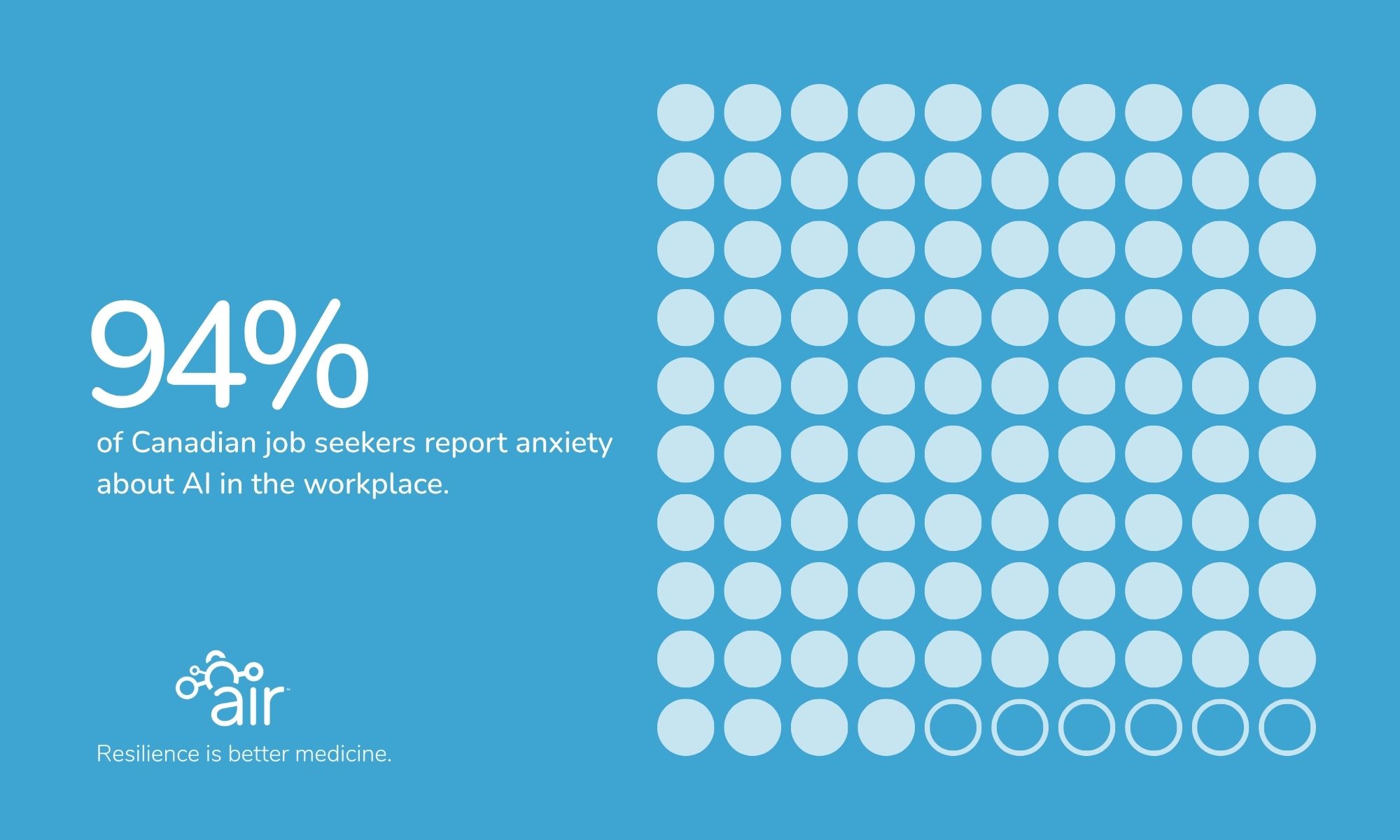
Source: Express Employment Professionals Canada Workforce Survey
Why AI Anxiety in the Workplace Is Growing
Throughout history, major technological shifts have created both opportunity and concern.
Artificial intelligence is no different.
Employees are asking questions such as:
- Will my role change?
- Will my skills remain relevant?
- What will my organization expect from me in the future?
- How quickly will these changes happen?
These questions don’t always have clear answers.
When people lack certainty about the future, their brains naturally begin scanning for risk. This is a normal psychological response designed to protect us from potential threats.
The problem is that prolonged uncertainty can also increase stress, reduce confidence, and make it more difficult to focus on what we can control.
This is why AI anxiety in the workplace is often less about technology itself and more about the uncertainty that accompanies change.
The Real Impact of AI Anxiety in the Workplace
Many organizations view uncertainty as a communication problem.
If we provide enough information, people will feel better.
While communication is important, uncertainty often persists even when information is available. This is because uncertainty is not only an organizational challenge—it is also a psychological one.
When employees feel uncertain, they may experience:
- Increased stress and anxiety
- Difficulty concentrating
- Lower confidence in decision-making
- Reduced engagement
- Greater resistance to change
Over time, these responses can impact both well-being and performance.
Organizations often focus on helping employees understand change. Yet understanding change and feeling prepared for it are not always the same thing.
People can know what is happening and still feel anxious about what it means for their future.
People Can Adapt to Change
One of the biggest misconceptions about resilience is that it helps people avoid stress.
In reality, resilience helps people navigate stress more effectively.
Research consistently shows that people are remarkably capable of adapting to change. What often creates difficulty is not change itself, but the uncertainty that surrounds it.
When individuals can understand what is happening, maintain perspective, and focus on what they can influence, they are far more likely to adapt successfully.
This is why resilience matters during periods of rapid workplace transformation.
Resilience does not eliminate uncertainty. It helps people respond to it more effectively.
Which Mental Muscles Help People Navigate AI Anxiety?
AI anxiety in the workplace is often framed as a technology challenge.
From a resilience perspective, it may be more accurately understood as an uncertainty challenge.
When people face rapid change, several mental muscles become especially important. These mental muscles help individuals manage uncertainty, maintain performance, and respond effectively to change.
Control
Control is the ability to focus your attention and energy on what you can influence rather than becoming consumed by what you cannot.
When new technologies emerge, employees often become focused on questions they cannot answer:
- Will my role change?
- Will my skills still be relevant?
- What will work look like five years from now?
Strengthening control helps people shift their attention toward learning, adapting, and taking meaningful action in the present.
Optimism
Optimism is the mental muscle of seeing possibilities and approaching challenges with hopeful expectations.
When uncertainty is high, it is easy to focus exclusively on potential threats. Optimism helps people remain open to opportunities, growth, and new possibilities while still maintaining a realistic view of challenges.
Regulation
Regulation is the ability to manage stress and remain grounded under pressure.
Periods of change often activate our stress response. Regulation helps individuals stay calm, think clearly, and respond effectively rather than reacting impulsively to uncertainty.
Planning
Planning provides structure during times of change.
When people have a clear path forward, uncertainty becomes easier to manage. Planning helps employees focus on practical next steps, skill development, and achievable goals rather than becoming overwhelmed by unknown possibilities.
Emotional Literacy
Emotional literacy is the ability to recognize, understand, and interpret emotions in ourselves and others.
Many people describe feeling anxious about AI, but anxiety is often a signal pointing to deeper concerns about security, identity, confidence, or the future. Emotional literacy helps individuals understand what they are experiencing and respond in productive ways.
Building Resilience for the Future of Work
The future of work will require more than technical knowledge.
It will require the mental fitness to navigate uncertainty, adapt to change, manage stress, and stay effective under pressure.
Organizations that invest in resilience are not simply helping employees cope with change. They are helping them build the skills needed to thrive through it.
Helping Employees Navigate AI Anxiety in the Workplace
Many organizations are focused on preparing employees for AI.
An equally important question may be:
How are we preparing employees for uncertainty?
Supporting people through change requires more than technical training.
It requires acknowledging concerns, creating psychological safety, and helping employees develop the skills needed to navigate ambiguity and disruption.
Leaders do not need to have all the answers.
But they do need to create environments where employees feel supported as they adapt.
Employees do not need certainty about everything.
They need confidence in their ability to navigate whatever comes next.
Organizations that successfully address AI anxiety in the workplace will be those that invest in both technological capability and human capability.
AIR Perspective
The future of work will require more than technical expertise.
As AI continues to reshape workplaces, organizations that invest in resilience alongside technology will be better positioned to support performance, well-being, and sustainable success.
Because the future of work is not only a technology challenge.
It is a human challenge.
Related Resources:
FRQ-12: Measure resilience in less than five minutes
AIR eCampus Resilience Courses
Our latest blogs:
- Building Organizational Resilience: Lessons from a Three-Year Partnership
- Why High Performers Burn Out: The Hidden Role of Recovery

- 46 Lost Working Days Per Employee: The Hidden Cost of Mental Fatigue
- Leadership, Not Labels: Rethinking Workplace Mental Health
- AI Anxiety in the Workplace: Why Uncertainty Is the Real Challenge