Canadian organizations are losing the equivalent of 46 working days per employee every year to health-related absences and reduced productivity.
That is more than nine standard five-day work weeks.
At first glance, this looks like an absenteeism problem.
But most of the loss is happening while employees are still at work.
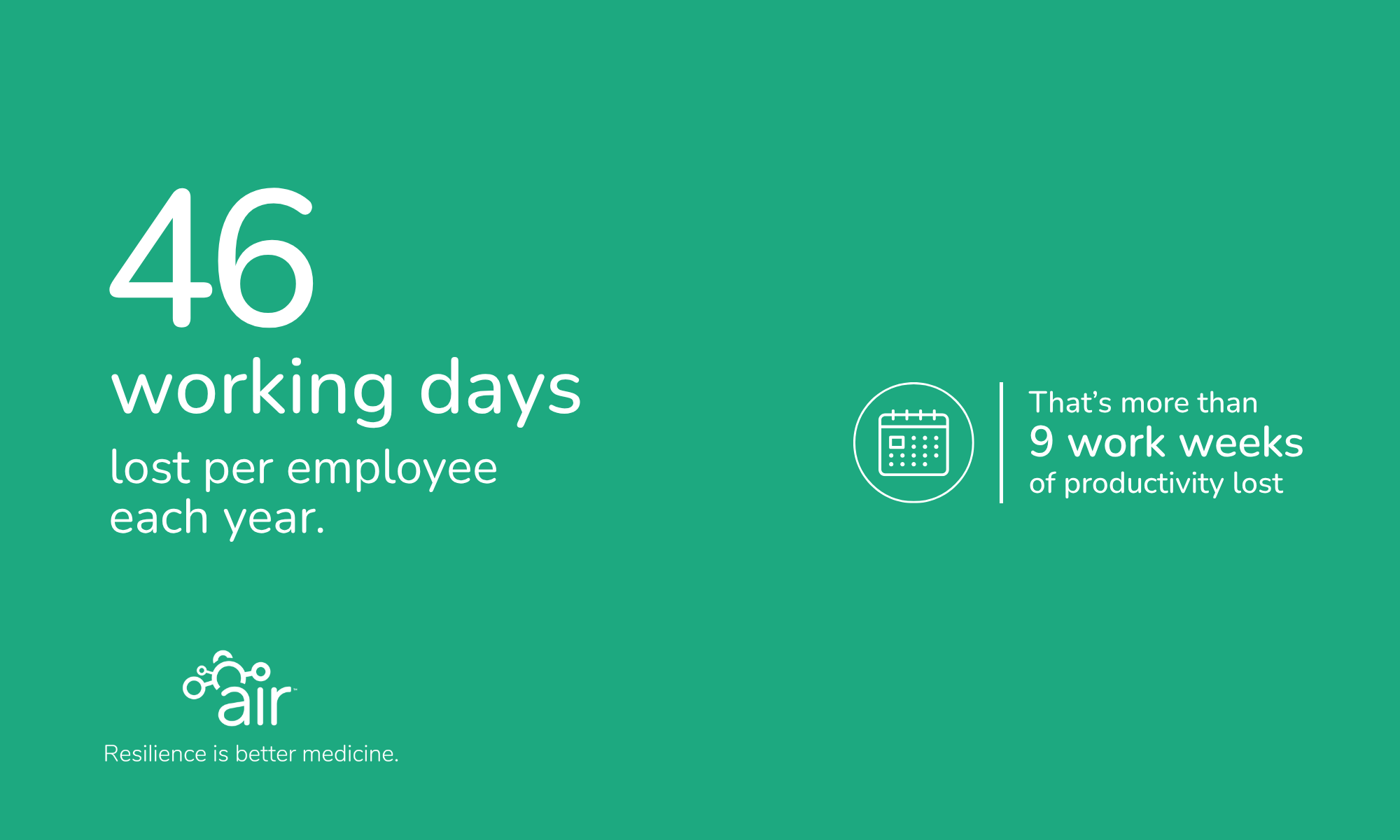
According to Manulife Canada’s latest Wellness Report, 3% of total working time was lost to health-related absences, while 19% was affected by health-related productivity challenges. Combined, this represents the equivalent of 46 lost working days per employee each year. The findings were based on responses from nearly 4,700 employees across 159 Canadian organizations.
The real challenge, then, is not simply whether people are showing up.
It is whether they have the capacity to perform when they do.
The largest productivity losses may be difficult to see
Absence is visible.
A missed shift, sick day, or leave can be counted and recorded. Reduced capacity is much harder to recognize.
An employee may be physically present while struggling to concentrate, make decisions, organize their work, collaborate effectively, or sustain their usual level of energy.
They may still attend meetings, answer emails, and complete assignments. From the outside, everything may appear normal.
But the effort required to keep going can increase while the quality, pace, and consistency of their work decline.
Manulife’s findings reflect this less visible reality. Among employees surveyed, 57% said mental health challenges affected their ability to perform their job, while another 57% reported experiencing burnout at work at least some of the time. Mental fatigue was identified by 19% as the greatest barrier to improving their mental health.
Productivity is also a capacity issue
Organizations often approach productivity through processes, technology, staffing, and performance management.
Those factors matter.
But productivity also depends on human capacity: the ability to think clearly, regulate stress, make effective decisions, maintain focus, and work constructively with others.
When that capacity becomes depleted, performance can be affected long before an employee takes time away from work.
This is why the equivalent of 46 lost working days should not be interpreted only as a health statistic.
It is also a business signal.
It suggests that organizations may be losing substantial productive capacity in ways that traditional attendance measures do not fully capture.
If capacity influences performance, the next question becomes: how do you measure it?
What does resilience look like in practice?
Before thinking about organizational solutions, it’s helpful to understand what resilience actually measures.
AIR’s FRQ-12 is a free, five-minute resilience snapshot based on the same mental fitness framework that underpins our comprehensive Functional Resilience Questionnaire. It introduces the core resilience skills that influence how people respond to stress, adapt to change, and perform under pressure.
Whether you’re a leader, manager, or simply curious, the FRQ-12 is an opportunity to experience AIR’s evidence-based approach to resilience firsthand.
Mental fatigue changes how people function
Mental fatigue is not simply feeling tired at the end of a long day.
Under sustained pressure, people can find it increasingly difficult to direct their attention, organize competing demands, maintain perspective, and respond calmly to challenges.
Tasks that would normally feel manageable may require more effort. Decisions can take longer. Interruptions become harder to recover from. Frustration can affect communication and relationships.
Over time, employees may continue meeting basic expectations while having less capacity available for problem-solving, innovation, collaboration, and adaptation.
This matters even more in high-pressure environments, where clear thinking and effective behaviour are central to safety, service, and performance.
Benefits support well-being. Mental fitness builds capacity.
Manulife’s report points to an opportunity for employers to make workplace benefits and health supports easier to understand, access, and use. It highlights resources including Employee and Family Assistance Programs, mental health practitioner coverage, digital health tools, physical health support, and financial wellness programs.
These supports are an essential part of a healthy workplace.
But organizations should also consider employees’ needs before stress becomes a crisis.
People benefit from practical skills that help them recognize their stress patterns, remain grounded under pressure, protect their capacity, and recover more effectively during periods of sustained demand.
That is where mental fitness and resilience development can complement existing benefits.
They do not replace clinical care, workplace protections, appropriate staffing, or organizational responsibility. They help equip people with additional skills for navigating the demands they encounter.
The resilience skills that support capacity
Several trainable mental fitness skills are especially relevant when mental fatigue begins affecting performance.
Regulation
Regulation helps people manage stress responses and remain effective under pressure.
It supports the ability to pause, regain composure, and respond intentionally instead of becoming increasingly reactive or overwhelmed.
Mindfulness
Mindfulness strengthens the ability to direct and sustain attention.
In busy environments filled with competing demands, this can help people notice distraction and return their focus to the task in front of them.
Planning
Planning helps people organize demands, establish realistic priorities, and break larger responsibilities into manageable steps.
When mental load is high, structure can reduce the effort required to decide what needs attention next.
Balance
Balance helps people maintain the habits, relationships, and activities that replenish their energy.
It recognizes that sustainable performance requires restoration—not constant output.
Boundaries
Boundaries help people identify limits, communicate needs, and protect their capacity before demands become unmanageable.
Together, these skills can help people function more effectively under pressure and recover more intentionally from it.
These skills aren’t fixed personality traits—they’re trainable capabilities. Strengthening them through evidence-based coaching and mental fitness training can help people perform more consistently under pressure while improving long-term resilience.
What leaders should take from the 46-day statistic
The goal is not to expect employees to remain productive regardless of the conditions around them.
Nor should resilience be used to shift responsibility for workplace problems onto individuals.
The leadership opportunity is to consider both sides of capacity:
What demands are being placed on people?
And:
What resources, skills, and support are available to help them meet those demands sustainably?
Organizations can begin by looking beyond absence data and paying attention to earlier signals of strain, such as declining focus, persistent exhaustion, greater conflict, reduced confidence, missed deadlines, and difficulty adapting to change.
They can also examine whether employees know where to find support, feel comfortable using it, and have realistic opportunities to recover.
This shift requires more than simply recognizing when someone is struggling. It requires proactively identifying resilience strengths, understanding where support is needed, and providing practical coaching before challenges lead to extended leave or declining performance. Programs like AIR’s Resilience InsideOut help organizations move from simply reacting to workforce challenges to proactively building resilience. Combining evidence-based assessment with personalized resilience coaching, the program helps identify strengths, uncover emerging risks, and support employees before challenges lead to extended leave, turnover, or declining performance.
Learn how Resilience InsideOut helps organizations identify resilience strengths, uncover emerging risks, and build a more resilient workforce.
Protecting capacity protects performance
The equivalent of 46 lost working days per employee is not simply time disappearing from a calendar.
It represents focus, energy, knowledge, collaboration, and productive capacity that organizations are not fully able to access.
Employers cannot eliminate every health challenge or source of stress.
But they can build workplaces that recognize strain earlier, make support easier to access, address harmful working conditions, and help people strengthen the skills required to navigate pressure.
Supporting employee well-being is not separate from protecting organizational performance.
It is part of protecting the human capacity that drives organizational performance.
Building a resilient workforce isn’t simply about preventing burnout—it’s about strengthening the capacity that allows people and organizations to thrive.
Source
This article was inspired by findings from Manulife Canada’s Wellness Report, published May 26, 2026. Manulife reported that health-related absences and productivity challenges amounted to 46 lost working days per employee annually under a standard five-day work week.
Our latest blogs:
- Building Organizational Resilience: Lessons from a Three-Year Partnership
- Why High Performers Burn Out: The Hidden Role of Recovery

- 46 Lost Working Days Per Employee: The Hidden Cost of Mental Fatigue
- Leadership, Not Labels: Rethinking Workplace Mental Health
- AI Anxiety in the Workplace: Why Uncertainty Is the Real Challenge